Switzerland compresses more extraordinary travel into a smaller space than almost any country on Earth — two of Europe's most culturally refined cities, a rail network that is itself a journey, and Alpine peaks that justify every superlative.
Written by the Explorify specialist team · Published 25 September 2026
Why Switzerland Belongs on Every Luxury Traveller's List
Switzerland occupies an unusual position in European travel — famous enough to appear on every shortlist, yet consistently surprising the travelers who approach it with genuine curiosity rather than assumed familiarity. The country most visitors imagine is all Alpine peaks and chocolate-box villages. The country they find contains two of Europe's most culturally refined cities, a rail network so precisely engineered it feels like a philosophical statement, lake shores of extraordinary beauty, and a countryside so concentrated in visual quality that artists have been coming to draw it for three centuries.
Scale matters here: Switzerland is compact — roughly the size of Denmark — and yet within its borders you encounter four distinct languages, three distinct cultural identities, and a landscape that moves from lakeside cities at 400 meters to glaciated peaks above 4,000 in the span of a morning's journey. The Switzerland Tourism authority describes the country as having compressed the extraordinary, and the description, for once, is not marketing excess. What it omits is that the compression rewards being moved through slowly.
Zurich: Europe's Most Underrated Cultural Capital
Zurich is frequently categorised as a financial city — efficient, expensive, and primarily transit-oriented. The travelers who discover its Old Town, its museum landscape, and its lake find something considerably more surprising. The Altstadt on both sides of the Limmat river is a medieval city of guild halls, Romanesque churches, and cobbled lanes that runs down to a lake whose clarity, on a clear day, reflects the Alps visible forty kilometers to the south. This is an urban experience of genuine quality — not a preserved heritage precinct but a living city center that happens to contain buildings from the twelfth century.
The Kunsthaus Zürich, expanded to its new wing in 2021, is now one of the largest art museums in Switzerland and holds a collection of extraordinary range — Giacometti, Munch, Monet, and exceptional holdings in contemporary Swiss and international art. The Museum Rietberg, in a garden villa on the edge of the city, houses the finest non-European art collection in Switzerland with remarkable pieces from Asia, India, and Africa. Zurich is not a museum city in the exhausting sense; it is a city where cultural engagement happens at a manageable pace, between meals that consistently justify the restaurant prices the city charges for them.
Lucerne and the Central Lake District
An hour from Zurich by express train, Lucerne is one of the most gracefully situated small cities in Europe — its medieval covered bridges spanning the Reuss river as it exits Lake Lucerne, the Pilatus and Rigi mountains rising directly from the opposite shore. The Chapel Bridge, built in 1333 and still functioning as a pedestrian crossing, is one of the oldest covered wooden bridges in Europe and carries a series of seventeenth-century painted panels depicting Swiss history in its triangular gable spaces. Standing on it at dawn, with the lake still and the mountains catching the first light behind you, is one of the quieter pleasures of Central European travel.
The lake itself is the attraction that most requires no narration. Steamer crossings to the villages on the southern shore — Weggis, Vitznau, Brunnen — deliver a pace and a view that no road journey replicates. Mount Rigi, accessible by rack railway from Vitznau, offers views across a landscape of interlocking lakes and forest ridges that have been drawing travelers since Goethe made the ascent in 1775.
- Chapel Bridge and Water Tower: The defining image of Lucerne, most beautiful at dawn before tourist crowds accumulate.
- Mount Pilatus: Reached by the world's steepest cogwheel railway from Alpnachstad — summit views extending to the Black Forest on a clear day.
- Lake Lucerne by private boat: A private motorboat for an afternoon passage through the lake's southern arms toward the meadow at Rütli — the founding site of the Swiss Confederation in 1291.
The Bernese Oberland: The Alps at Their Most Dramatic
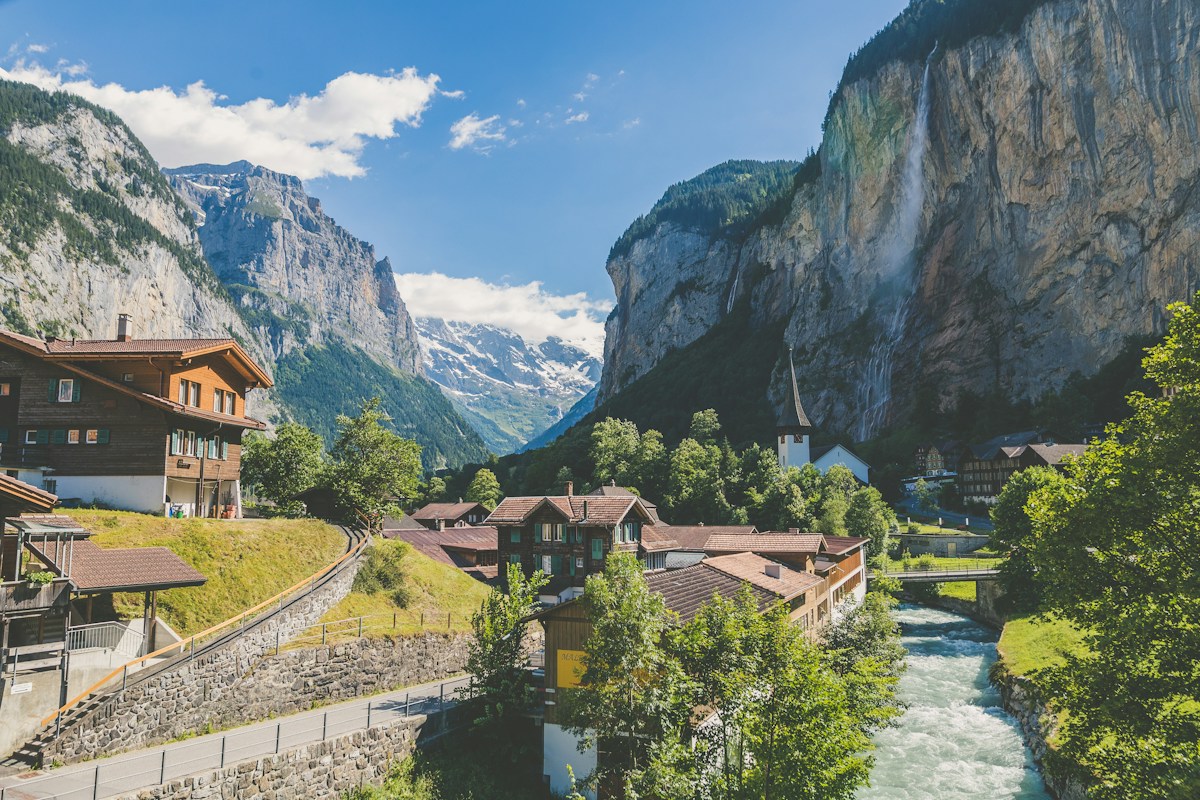
The Bernese Oberland is the Alpine landscape the world has reproduced most — the Eiger, Mönch, and Jungfrau above Grindelwald, the Lauterbrunnen Valley with its 72 waterfalls, the Männlichen ridge walk with unobstructed views of the great north faces. The UNESCO World Heritage-listed Swiss Alps Jungfrau-Aletsch region encompasses the longest glacier in the Alps and a landscape of such scale that even seasoned Alpine travelers fall quiet when they first encounter it from above. The Jungfraujoch railway station, at 3,454 meters, is the highest in Europe — a journey that ascends through the Eiger and Mönch by tunnel before emerging onto the Aletsch snowfields in conditions that feel, genuinely, like the top of the world.
The luxury accommodation offer in the Bernese Oberland has evolved significantly: historic grand hotels — the Bellevue in Grindelwald, the Victoria-Jungfrau in Interlaken — combine belle époque architecture with mountain views that justify every superlative. Private guided hikes to viewpoints the marked trails do not reach, helicopter transfers between valleys, and private ski instruction during winter complete an experience that extends well beyond cable car and gift shop.
The Great Swiss Train Journeys
Switzerland's rail network is, in the most literal sense, both an engineering achievement and a travel experience in its own right. The Glacier Express — from Zermatt to St. Moritz, crossing 291 bridges and 91 tunnels in under eight hours — is the most famous, but the Bernina Express, the GoldenPass Line, and the William Tell Express each deliver a distinct combination of landscape and engineering that no comparable journey in Europe can match. In a private or panorama car, these are among the finest slow journeys available in the world — a way of understanding Switzerland's geography that any series of valley drives cannot replicate.
For a privately designed Swiss itinerary — combining Zurich's cultural depth with Lucerne's lakeside grace, the Bernese Oberland's Alpine drama, and one of the great train crossings — speak with our European specialists about designing the journey around your interests and travel pace. Switzerland rewards unhurried attention in direct proportion to the time given to it.