Most travellers pass through Singapore on the way somewhere else. The ones who stay — three nights, five nights, a week — are consistently the ones who tell us they should have come for longer.
Why Singapore Deserves More Than a Layover
Most travellers first encounter Singapore as a transit point — a gleaming, efficient hub between Europe, Australia, and the rest of Asia. It is, admittedly, one of the world's great transit cities: Changi Airport has held the top ranking in nearly every major airport survey for the better part of two decades. But the travellers who build a full stop into Singapore — three nights, five nights, a week — are consistently the ones who tell us they should have come for longer.
Singapore is a city-state of remarkable complexity compressed into 733 square kilometres. Its four main cultural districts — the colonial centre, Chinatown, Little India, and Kampong Glam, the Malay quarter — each maintain a distinct architectural character, a distinct food culture, and a distinct rhythm that rewards unhurried walking far more than any curated tour. The Singapore Tourism Board promotes the city as a world stage for experiences, and the characterisation is justified.
The Hotels: A Benchmark the Rest of Asia Measures Against
Singapore has one of the most consistently excellent luxury hotel landscapes in the world. The Raffles Hotel, which has occupied its neoclassical colonial building since 1887, represents the pinnacle of a certain kind of grand old-world hospitality — long colonnaded corridors, immaculate service, afternoon teas served in the same Palm Court where Somerset Maugham once sat. Its recent restoration is among the most thorough and respectful of any historic hotel in Asia.
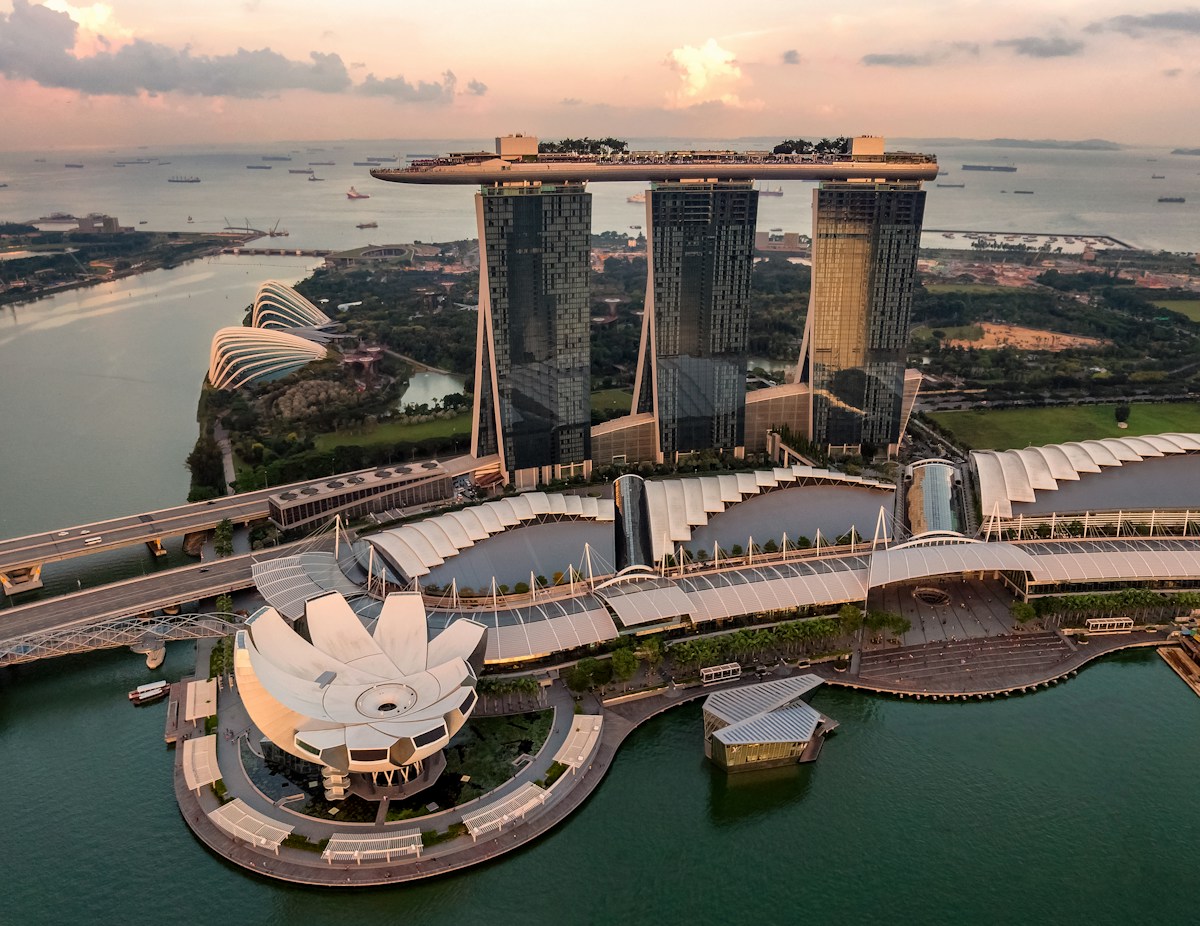
But Singapore's hotel landscape extends well beyond heritage. The city is home to exceptional contemporary properties from the world's leading luxury hotel groups, including properties built into the Marina Bay development that offer views of the extraordinary skyline across the water. The decision between a colonial-era property in the civic district and a contemporary tower overlooking the Bay is less about quality — both deliver exceptional service — and more about which Singapore you want to anchor your stay around.
The Food: Why Singapore Is One of the World's Great Eating Cities
Singapore's food culture is an argument for the virtues of a multicultural society made edible. The hawker centre tradition — open-air food markets where individual stalls have specialised in single dishes for generations — is so deeply embedded in the city's identity that UNESCO added Singapore's hawker culture to its Intangible Cultural Heritage list in 2020. Maxwell Food Centre, Lau Pa Sat, and the hawker centres of Chinatown each offer a different cross-section of the city's food traditions — Hainanese chicken rice, laksa, char kway teow, Malay satay, Indian roti prata — at prices that remain almost impossibly accessible.
The Michelin-starred level is equally impressive. Singapore's restaurant scene includes multiple three-starred establishments and an extraordinary range of contemporary Asian and European fine dining that draws chefs and food writers from around the world. A dinner at one of the restaurants overlooking Marina Bay, followed by a hawker supper in Chinatown, is as Singaporean an evening as you can have — and the contrast between the two is precisely the point.
- Best hawker centres: Maxwell Food Centre (Central), Lau Pa Sat (financial district), Old Airport Road Food Centre (East)
- For fine dining: The Marina Bay area concentrates the city's highest-end restaurant scene; book well in advance for any starred establishment
- Neighbourhood dining: Tiong Bahru — the city's oldest planned estate — has a café and bistro scene that rivals anything in Melbourne or Copenhagen
Beyond the City: Gardens, Museums, and the Singapore River
Gardens by the Bay — with its Supertree Grove and climate-controlled Cloud Forest dome — is among the most architecturally ambitious public garden projects in the world. The National Museum of Singapore and the Asian Civilisations Museum sit within a short walk of each other in the colonial district and together provide a genuinely impressive context for understanding Singapore's history and its place within the broader narrative of Asia.
The Singapore River, once a working waterway lined with godowns, is now the city's most pleasant promenade — the Quays that flank it (Boat Quay, Clarke Quay, Robertson Quay) each occupying a slightly different register of the city's leisure life. Sentosa Island, connected by cable car and road, offers a more resort-focused experience — beach clubs and private villa properties looking out across the Singapore Strait toward Indonesia — within 20 minutes of the city centre.
Combining Singapore with the Region
Singapore's position at the tip of the Malay Peninsula makes it one of the natural gateways for broader Southeast Asia travel. A private journey that begins in Singapore, continues to Penang or the rainforests of Borneo, and moves on to Bali or the Indonesian archipelago creates a regional itinerary of genuine depth — each destination distinct, each connected by short, comfortable flights. If a Singapore-anchored Southeast Asia journey is taking shape in your thinking, speak with our Asia team about designing the route that fits your interests and your timeline.